The Story of C.R.E.A.T.E.

Tuesday, November 16, 2021

The Same Amount of Blood

One of the commonly held myths about school is that our primary function is to teach children. In fact, our goal is to send home the same number of children in the afternoon that we received in the morning, with the same number of fingers and the same amount of blood that they had when they arrived. Safety is our mantra.

To support that, we hold yearly, mandatory, 30-minute safety briefings for each class. Until every single class (and teacher) has attended a session, we do not open the space for use.

Presenting kids with a long list of rules would be ineffective, not to mention boring. Instead, we have a single safety "Prime Directive." Make the safer choice. That's it. I do have a safety poster with some rules on it, but I don't mention it in detail during the briefings other than to note its presence on the wall. My main goal during the briefing is to communicate respect and trust.

CREATE safety poster.

I also do some role playing with hot glue guns and box cutters, but that's more to demonstrate to the students that they already know how to behave safely. My favorite "gotcha" question is "How fast are we allowed to run with scissors?" That kills both the running and scissors "birds" with one joke.

We also establish the safety culture in CREATE by differentiating it from other experiences they might have. Their parent (or teacher) might warn them about the consequences of unacceptable behavior with sentences that begin with, "The next time that you...," followed by some threatened consequence. In CREATE, unsafe behavior is zero tolerance. The first time a student chooses to do something unsafe, they are banned from the room for the day. If it happens during lunchtime Tinker Time, they have an immediate conversation about safety with the principal. In the six+ years we've operated CREATE, we've only had to do it three or four times.

Emotions count

When the inevitable small injuries happen, it's important to remember that students mirror our reactions. I always approach minor cuts and burns with an air of empathy mixed with a bit of reassuring nonchalance. A scared child will only ramp up their fear if their adult signals that something serious has happened. Give them 100% of your attention, but under-reacting is the best starting point.

Safety culture needs to reflect and serve the community. If success can be measured by the few minor cuts and hot glue gun burns we've had over the years, our approach has worked well so far.

Wednesday, September 29, 2021

Kobayashi Maru

Starfleet cadet, James T. Kirk was doing standardized testing. Faced with a deliberately impossible test, designed to evaluate his behavior in a no-win situation, he cheated (or did he?) He reprogrammed the simulation computer to permit a solution to the Kobayashi Maru Test.


School makerspaces are not about products, they are about training minds and imaginations to solve problems. They are also about learning that not every problem has a solution and how to engage with that reality.  In real life, if a student reprogrammed a standardized testing computer, they would be expelled and possibly prosecuted. Makerspaces are safe places where they can color outside the lines.

Progression: Four year olds are "free players" with unfettered imagination. Six year olds are all about rules and fairness, even to the point of creating rules on-the-fly to benefit themselves. As students grow, they grow to be more like most typical adults – cautious, habitual and ordinary. We want to intervene before they lose their exploratory courage.

But a "Kobayashi" approach isn't just about thinking outside the box. It can be about adopting an adversary mindset – a recognition that the world is not the friendly, supportive place we foster in our classrooms. As military writers Gregory Conti and James Caroland recognized in their 2011 article about cheating:
"We learned much from the students during the course of this exercise. They embraced the test, proved far more devious than their day-to-day personas let on, and impressed us with their ability to analyze and defeat the inherently flawed classroom system."
Conti, Caroland
IEEE Security and Privacy
July/August 2011

This is why makerspaces that primarily utilize "recipe" projects where students all use the same components and end up with the same object are not as educationally effective as those that present a problem or a need, (or a Project Based Learning driving question) and let students design their own solutions. It's not about what students end up with, it is how they get there. The learning does not happen by executing somebody else's idea, it happens in the struggle to solve a problem.

Monday, June 24, 2019

So, Why Are We Even Doing This?

MakerEd is not, repeat, not shop class. We are not (not!) training people how to build things with their hands so they can go out and build those things for a living. We are teaching them how to think. We are teaching them the same traditional things, math, social studies, science, etc., that we always have. We’re just doing it in a way that allows the learning to persist beyond standardized testing.

Automation has displaced millions of workers over the past generation. In recent years, half of those displaced workers have exited the workforce, never to work again. This means that more of our students, than has been the case for the last century, will have no jobs at all.
"Approximately 25 percent of U.S. employment (36 million jobs in 2016) will face high exposure to automation in the coming decades (with greater than 70 percent of current task content at risk of substitution)."
Muro, Maxim, Whiton, Hathaway
Automation and Artificial Intelligence
Brookings Institution
January, 2019

We must avoid becoming "product fixated." If a student fails to complete a project, but showed excellence in the design of a portion or component, we should consider giving more weight to that subset. Individualized education is inherently "unfair" in the traditional sense – that is it is not equal, it is equitable. Students' ability to push through failure, collaborate, adapt and synthesize are far more important than an end-of-the-unit widget.

So what we’re doing is training people to live. We’re training people to deal with the challenges in life that we cannot predict. We’re training people to analyze and solve problems that no one has thought of. We're training them to become the fellow citizens that we all need.

Wednesday, May 15, 2019

CREATE and the art of growth

All of us are born makers and innovators. Just have a conversation with a five-year-old. Their sense of the world has not been solidified or limited by experience. Everything is possible. Our kindergarteners are new to our school and to CREATE. Creating nine kinds of pies with a purple crayon is totally plausible to a five-year-old.

For the past 100+ years, the traditional school system has been about suppressing innovation in favor of standardized knowledge. Students were the output of a system intended to "manufacture" factory workers. "Creative" workers were a problem in a system where every human component was supposed to be interchangeable. Creating learners who could grow independently was simply not part of the plan.

To many people, school is about preparing learners for "21st century jobs." Yet, there is no way that we can know what those jobs are. 10 years ago, I could not have described my job. It didn't exist. It is the heights of hubris and arrogance to think that we know what the jobs of 15 years from now will be.

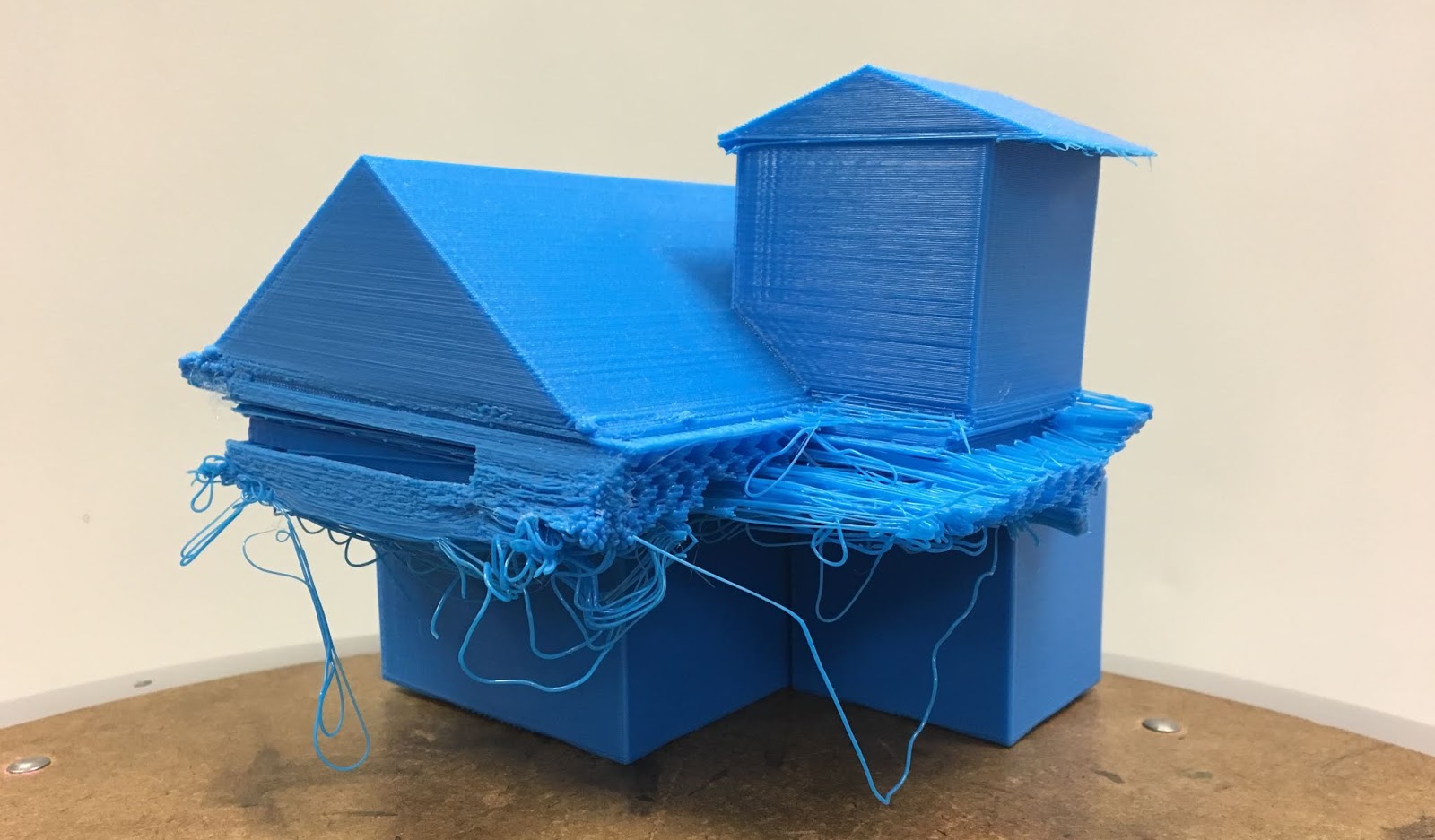
Failed 3-D print.
So we take a different approach to learning here.

An engineer is somebody who uses their mind to solve problems in real life. Technology is a thing invented via the engineering and design process to solve problems. Our makerspace, CREATE, is where those things come together.

But we're not an engineering principles class. We encourage students to not only define their own techniques, we ask them to define their own goals. CREATE's culture is deliberately built as a safe place for failure — and learning by analyzing those failures. Questions like "Why didn't it do what I want?" and "How can I change it to make it better?" are the background music that indicates learning success.

We can't reliably guess where our students will end-up. So we must provide them not only with the techniques to learn anything, but with the confidence that they can do anything.


Thursday, March 14, 2019

Aspirations, not standards


Integrating MakerEd into education has to honor the expectation of benchmarks, if not standards. Even though I've been really plugged-in to social media for decades, I couldn't find a list of maker skill progressions anywhere. So, with the help of people all over the country, I made a Maker Skills Progression Google Sheet. It's a living document that still has some gaps. Please feel free to comment on it.


This rubric is a spectrum of mastery levels for particular skills. In other words, "Once you do this, then you can aim at this." It’s a tool for teachers to encourage progress, regardless of a specific student's starting point. It can be used for any age. For example, I’m probably a Level B in sewing and a Level D in soldering. We should not expect, let alone require, students to be all Es in all skills.

These aren't standards. (Not standards!) They are aim points and guides for individual classroom teachers. It should be perfectly acceptable for a given student to be a Level B in one skill and an E in another. The rubrics are strictly aspirational. Origami and 3-D design do not have to be for everybody.

Once students are at Level E, then that skill is just a tool they’re good with. After that, it’s totally about their content — what they make and its educational validity.

As a teacher, the levels let you know what quality level of craftsmanship to expect from a student. Theoretically, a student with B-level skills and a student with E-level skills could both get graded highly on a given project — if they have great content. Conversely, a student with E-level skills could get a low grade if they didn’t work up to their known level of craftsmanship.

It's a challenge to educate the profession that this is not a continuation of the way we’ve always done things. If a teacher is looking for standards boxes to check off, then we have not done our job right in educating them about how maker education works. Traditionally trained teachers often look for checkbox standards and we need to head them off. Early childhood development experts, physicians and occupational therapists can identify what specific hand-eye coordination and manipulative benchmarks are appropriate for a given age. Those evaluations lie outside of mainstream maker ed.


Tuesday, February 12, 2019

Learning to "ROAR"

CREATE(ing) time


If you ask any teacher what one thing that they need more of (besides money) they will tell you that they need more time. We found a way to "create" more time for teachers without diminishing the students' classroom experience. For a week each month, we bring in substitute teachers for each grade level per day and send their students on an all-day rotation through STEAM activities. The teachers spend the entire day on professional development and prep time.


Tuesday, January 29, 2019

Making Sacrifices

Sacrificial workbench tops

Wear and tear is one of the things built into our workbenches. Students will cut without mats, scraping-up hot glue damages the work surfaces. In other words: School happens. So the tops of our workbenches are sacrificial. Every year or two, we rip them off (they're attached with a minimum of silicone glue) and replace them with new tops.

Old bench top about to be replaced. New surface is visible in the rear.
Our original tabletops were a thin white plastic designed to be attached to a wall. But it was so thin, that when the temperature in the room changed, the material warped and made for an uneven work surface. The second version was whiteboard paneling, but the white surface was too thin to withstand day-to-day punishment (see photo above.)

Our current version is fused laminate board, designed for custom cabinets. It's actually donated scrap from a local company, which they generously cut to the exact size for us. As of this writing, it's been in use for five months and is standing up very well.

Links

Workbench Plans

Original surface (bad)

Donated sheets of thermal fused laminate board


Thursday, May 10, 2018

Making hot glue guns safer

We rely a great deal on the kindness of strangers. Sort-of strangers, actually. Much of our material is donated by our families or by businesses with ties to our staff and others. We were recently gifted with three gently used hot glue guns. The problem was that they were switchable between low temperature (105C) and high temperature (165C.) While 105C is hot enough to get your attention and even cause tears in a student, the burns are typically minor and painless after less than an hour. High-temp hot glue guns can quickly cause serious burns and scarring if not treated quickly.


So I broke them. Well, not exactly broke. I disabled the temperature switch after setting it to low temperature by putting a drop of hot glue into it.

Thank you, strangers. (The stranger in this case was Mrs. Mark, who finally decided to part with our in-home elementary arts and crafts tools. Our youngest kids are now in college.)

Thursday, March 29, 2018

Resurrecting CREATE

Last Spring, our campus became a construction site. Portable classrooms were trucked in, regular classrooms were emptied, concrete broken up and poured, all while school continued. Our administration building, including the staff' lounge, was closed down with the main office moving into a portable. This meant that CREATE would be temporarily repurposed as a combination of the staff lunch room, copy room and, for good measure, we moved the staff mailboxes in. All of the makerspace stuff was packed into boxes and stored.


When the students returned in August, there was a lot of residual campus makerspace culture that had lacked a central place of expression. I constantly fielded questions from frustrated makers who wanted to know when CREATE would reopen.

But our maker culture has more momentum than anything that could be overcome by the temporary closure of CREATE. As I've said many times, all of De Vargas is a makerspace. Making continued in classrooms in concert with our Project Based Learning ethos. But, that tinker time itch of free making was still not getting scratched.

On Halloween, that ended...

The storage containers disgorged their contents of boxes marked "Room 8," (CREATE's "real" name.)  Over two weeks I unpacked and restored the room to our friendly, comfortable, making environment. I was able to revisit some of our storage and removed almost all of the remaining cabinet doors. The only ones left cover dangerous tools or materials, cleaning supplies, and sink plumbing. Everything else is now wide open with much more in the students' reach.

We're back to campus normal again.

Thursday, September 7, 2017

CREATE Adds a Lego Wall


More than a year after our Donors Choose campaign, we finally inaugurated our Lego wall. Here's the explainer video:


Friday, August 25, 2017

Consumables


I just thought I'd post a list of the things that we purchase to keep CREATE moving. These are non-"junk" consumables. Typically purchased, not donated.
  • Duct tape
  • Masking tape
  • Low-temperature hot-glue sticks
  • Adhesive glue sticks
  • LR44, 2032, AA, 9-volt batteries
  • Rubber bands
  • String (various)
  • Solder
  • 18-gauge single-strand copper wire (various insulation colors)
  • Box cutter replacement blades
  • Nails
  • Wood screws
  • Carpenters glue
  • White copy paper
  • Graph paper
  • Construction paper
  • Pencils
  • Crayons
  • Markers
  • Acrylic paints

Tuesday, June 27, 2017

Old Toys, New Tools

We have a new Lego Wall, now what?

Tools can be engaging, making can inspire agency, but all of it needs to support education.

I saw a Lego wall at a friend's Fab Lab. It was a section of square Lego tiles mounted vertically on a wall. Students could build projects or, (and this was cool) marble runs. But a Lego wall isn't just fun. It's a sophisticated educational tool that connects to a variety of education skills across the grade levels. I had to have one.

My high school and college-aged kids Legos were now disused. I could donate them to the project, but we only had one of the 64 7x7-inch Lego tiles needed for the project. A DonorsChoose campaign languished for a while until an anonymous donor swooped in and paid for nearly the whole thing.

Our sister middle school provided a massive plywood substrate upon which to mount the tiles. The whole things easily weighs more than 300 pounds. So make sure your mounting system is substantial. We used an interlocking wooden cleat system that runs the full width of the plywood.


We followed Dana Rendina's excellent plan for How to build a Lego Wall. If you build one, read Dana's page. She will keep you from making some of the most common mistakes.

So now what do we do with it?

I created a brief video showing a simple marble run and a short document describing the wall and listing a number of relevant NGSS and CCSS standards that could be addressed via projects and exercises using it.


Schools resumes in six weeks. There's no doubt that the students will create ways of using this new tool that I cannot imagine.

Monday, October 10, 2016

"Noun-Verbers"

I implemented Mrs. Dickson's unintended inspiration. If you recall from "Mrs. Dickson's Protein Sprayer," I took a misunderstood phrase and came up with the idea of taking random nouns and verbs to make a prompt to build a physical device. Builders not only have to understand the words they get, but then they would have to build a thing that logically tied-into those words.


As always, the the students exceed expectations. One selected the words "house" and "deliver." I would have thought that a "house deliverer" would be something that delivered houses. But that is not what she thought. Her house deliverer was a house that delivered things.

The next step is going to be making a story, in any form, based upon the thing they build.

Sunday, September 11, 2016

Coding exercise


Here's a cool Python tool to play around with. Change the variables and press the play button. If you mess-up, click on the three horizontal lines and select Reset.


Saturday, July 30, 2016

Makerspaces: Why and How (In That Order)

Video recorded from a live Google Hangout On Air for EdCamp Global on July 30, 2016.
(46:00)

Saturday, June 18, 2016

Memorializing Your Work

After a while you just run out of room for memorabilia. I know that I cannot keep every project. Some of them contain expensive components that have to be re-used. Others are simply too big or too fragile. Still others are team efforts and, lets' face it, you can't win 'em all.

But recording and sharing projects is an important part of the design cycle and of the Maker ethos.

I recently completed a project at the Design, Do, Discover Conference in Palo Alto, Calif. I worked with a tremendous team of educators on a sound-visualization project based on Charlotte's Web. The project used farm-animal audio files, triggered by a Scratch-controlled Makey Makey along with a plastic membrane suspended over a speaker causing sugar to visibly vibrate with each sound. The trigger buttons were cartoon animals including the actual sound waveform, laser-engraved into plywood. This allowed users to also feel a representation of the sound.

I shot video and still images all along the design and construction process.


After the project was disassembled and the Makey Makey and speaker returned to the Bourn Lab at host Castilleja School, I grabbed the part of the project that I worked the most on: the vibrating membrane that showed sugar moving in concert with the animal sounds.

What I didn't think about was that the interior temperature of my car exceeded the point where the cup, under pressure of electrical tape and a rubber band, could hold its structural integrity.


Luckily, I had the video.

And the cow. I also grabbed the cow.


Thursday, June 9, 2016

Mrs. Dickson's Protein Sprayer

Bear with me on this. I promise that I'll get to a very cool tinker-time tool.

During the last school year, CREATE shared duties as our school's art room, so I had a lot of contact with our fabulous art teacher, Mrs. Dickson. One day, she and I were talking and she made reference to a "protein sprayer." Since Mrs. Dickson grew up in her native Japan, and "protein sprayer" was such an unusual reference, after I stopped my silly giggling, I asked her to repeat herself. As it turned out, she had said "pro tennis player,' which actually did make contextual sense. And it got me thinking...

What was a protein sprayer? What if somebody tried to build one? What if students were given random nouns and verbs and asked to build the object suggested by that combination?

Here's the recipe:
  1. Generate a list of random nouns.
  2. Generate a list of random verbs.
  3. Print each list and cut the words up into separate pieces.
  4. Put the verbs into one container and the nouns into another.
  5. Have the students pick a noun and a verb.
  6. No matter what they pick, they are then committed to designing and building that thing and describing its function.
Imagine the possibilities when students build river separators or toothpaste concentrators or ghost traders...

Thursday, June 2, 2016

Taking charge, getting it done

It was just an afterschool 1st-grade tinker time session. But they came rushing in with a goal. It was a classmate's birthday and they were making a "cake." Their sense of mission was breathtaking. They were a well-oiled project management team.


They didn't have time to finish the cake, so they took the components away with them. I do know that they left just a bit more practiced in collaborating, solving problems and with more confidence in themselves.

Friday, May 20, 2016

Non-Newtonian Rattlesnake


It started with a plan to make a "rattle." Rather than accept a plan to throw some hard stuff into a bottle and call it done. I asked, "what kind of rattle?" "What will it sound like?" The student said, offhandedly, ""Like a rattlesnake." I pressed him to identify what a real rattlesnake sounded like so he could gauge the effectiveness of his build. We used my laptop to search for rattlesnake sounds.

After choosing a sound he liked, he then chose just the right mix of rice and beans to match the recording.

Of course, his buddy's unopened box of Nerds candy also sounded exactly right.


An exploration of non-Newtonian fluids with cornstarch and just the right amount of water. When it's mixed just right, it will pour, but if it is subjected to a sudden pressure, it will act like a solid. Plus it feels really good!


Monday, April 4, 2016

Cubbies Part 3: Organic Quality Control

It's interesting to see the students gain knowledge and confidence. They've got measuring down and now I've introduced laying out multiple cuts on a single piece of wood to minimize waste. I suggested that they measure the stock in both directions to see if that made any difference in how many finished pieces they could get out of it.

They've independently developed a system of cooperative production and quality control. An eraser is a favored tool. They now understand the level of precision required in what they're doing.


Lightbulbs are switching on, big time.