The Story of C.R.E.A.T.E.

Wednesday, April 1, 2026

My AI "Line"

I found my AI “line.” I really don’t care if the information that I read was constructed with generative AI. As long as it’s accurate and engaging, it’s fine with me. But it does bother me when I’m reading something that is presented as the authorship of an individual. When some person positions their content as coming “from“ them, that’s when I expect the words, phrases, and choice of language to be theirs alone. If I discover that it is not, I feel betrayed.


Man's thoughtful fave. The left background is a library. The right background is a chaotic digital world.
From Google Gemini
When I follow an author or columnist, it is a type of personal relationship. I’ve given that author my intellectual and personal trust. I’ve certainly given them my time. When AI is done badly and obviously, I feel like the “author” was trying to con me. They make themselves look foolish and whatever their message might have been is lost. My relationship with them is over and it sure as hell was them, not me.

The choice of words, phrases, and verbal craftsmanship imply personal qualities that should be genuine.

How would you feel if you were a fan of Stephen King only to find out that his work had been ghostwritten by John Grisham? And you don’t even like John Grisham.

If I follow your work and you are using generative AI non-transparently, your betrayal of me is in suspension, pending my discovery of it. Maybe I’ll never find out. But the disingenuousness remains. The qualities that I might admire in you, aren’t even yours.

Not everybody can be Hemingway. But have the confidence in, and respect for, yourself to be transparent about the parts of your offerings that aren’t you.

If you’re going to use AI, be honest about it. But don’t abuse my trust. That’s where I draw the line.

Tuesday, May 27, 2025

AI and real breasts

In the 1991 movie, LA Story, Steve Martin’s character is in bed with the character portrayed by Sarah Jessica Parker. Martin says, “Your breasts feel weird.“ To which Parker casually replies, “That’s because they’re real.“ We’ve reached that point with commercial writing and generative artificial intelligence. Some clients are so paranoid that contractors might be using AI, that they’re calling out human-written content because it sticks out from the gray, banal, cliché-filled drivel that they have become used to in the corporate world.

Image from ChatGPT

This demonstrates a couple of things. One, is that AI tools are starting to become ubiquitous and the other that the corporate standard is not “the best available.“ It’s “good enough“ or worse, “what we’re used to.“ That's great news for AI companies. The statistical middle is where large language models excel. They’ve been trained on decades of average writing and corporate speak. They’ve literally been training all of their silicon “lives” for this moment.

It was much the same in the 1980s when word processors became widely available. There was lots of mediocre writing because most people are mediocre writers. In the 1990s, it was the same when consumer page-layout software debuted, because most people only think that they are graphic artists (think Comic Sans.) Ironically, the above is the literal cause of the banality of AI tools–all of that mediocrity was used to train them.

Some writers have taken to including disclaimers that their material was human written. Of course, the next addition to AI prompts will be to routinely include such a disclaimer even in AI-generated content. This struggle can only end with a general acceptance of AI-based writing tools.

In these dialogues about AI involvement in social media posts, many people overestimate their ability to perceive humanity. Generative AI will certainly continue to improve its ability to effectively simulate human origin. If readers can’t accurately discern AI sourcing, then that value will be based purely on content, reputation, and branding.

Without in-person meetings, “human connection” is largely imaginary — even when real. Whether one’s long-distance romantic relationship is with a human or a chatbot is functionally a philosophical concern, if you can’t tell the difference. Increasingly, many people won’t care — or even want to know.

Tuesday, April 29, 2025

Making us human

Makerspaces are in-person experiences. You have to be in the room to cut the cardboard. But who is “you?“ One of the things that we keep hearing in the dialogue around artificial intelligence in education is that AI can never replace teachers. (Everyone in the room typically nods their heads in agreement.) But is that true? Will teachers never be replaced by AI? Let’s start with online classes. For the moment, let’s assume that all of the students want to be in the class and are not using bots or avatars. Every function of the teacher can now–today–be convincingly simulated by AI. The teacher‘s face can be generated in video and synchronized with a nearly flawless colloquial, idiomatic voice. AIs have been able to answer questions with a fair degree of accuracy, for years. That accuracy increases daily as models grow more sophisticated. The more specialized an area of discussion, the more reliable the AI responses.


Image from ChatGPT
It’s human nature to prefer that the entity one is dealing with be an actual human. Nobody likes dealing with AI customer service. There's something vaguely insulting about it. But what if we can’t tell the difference? Even if we know that we are dealing with an AI, if it’s sufficiently convincing, after a while, we forget and start interacting with it as if it were human. Have you said "please" or "thank you" to ChatGPT? People will anthropomorphize the heck out of almost anything. When the “thing“ is convincingly human, we will almost certainly emotionally process that relationship in a way that is equivalent to that of an actual human. People have already engaged in romantic relationships with AI’s. AIs have become celebrities with large fan bases. Human psychotherapists have migrated from the office to the screen. There have been experiments with AIs in that realm, albeit with significant legal indemnification.

Look, I love my teacher colleagues as much as anybody. I think that what they do in the classroom is magic. But there’s really nothing magic protecting teachers from being replaced by artificial intelligence. It won’t happen today, but it will happen very soon in online environments. In-person teaching, particularly in elementary and early childhood education, will take longer. It will require convincing robotic human analogues, which are likely decades away. Kindergarten and preschool teachers will be the last to go.

But we live in a pragmatic world. If something works, or if it makes money, it will be implemented. Unless we exert our collective will, the forces that drive education will be economic ones. Machines are cheaper than people and easier to manage.


Sunday, February 16, 2025

A changed mission

There have been quite a few articles written by educators, urging operational AI education as a way for students to remain relevant in the work world. By “operational“ I mean the training of people in how to use AI tools in their daily work.  While, some of these articles do open the dialogue a bit wider by giving a passing acknowledgment to larger societal effects, most make the same mistake. There is no way to ensure employability in a post-AI world. We can’t operate as if society still offers equal opportunity to those willing to put in the effort. Indeed, it never did. 

Assembly line building human workers
Image from Chat GPT
While learning to incorporate AI tools into one’s professional workflow will be mandatory for those remaining in the workforce, obtaining those tools will not be an assurance of landing a job. Remember, the fundamental reason for corporations to integrate AI tools is to reduce the number of workers.

While most AI tools are not currently able to replace workers 1:1, they can significantly increase the productivity of nearly every worker today. Increases in individual productivity enable workers to replace multiple colleagues. This will result in a reduction in available jobs that is so large that it will fundamentally change society.

The mission of education is no longer solely to create workers. Deciding what it will be is the challenge that we should be spending our time on. 

Monday, July 29, 2024

The Blind Men and the Blind Elephant

In the old story about the blind men and the elephant, each man stood near a different part of the elephant and described what they thought the elephant was. The one who stood near its tail pronounced the elephant to be a rope. The one near a leg was sure that it was a tree, etc. The various perspectives on artificial intelligence are often the same, with just as much under-informed confidence that the blind men had about the nature of the elephant.

Four blind men and a blind elephant
Image from ChatGPT
There are people who use generative AIs to do calculations, something for which they were never intended, and they write the tools off as totally useless. Others use them as search engines, another function that they do poorly. To them, all AI tools are undependable. They ignore the fact that the AI "elephant" is also "blind" and is not able to differentiate between fact and fiction. Still others briefly try the tools without spending the necessary time to learn their weird ways and they walk away without gaining the skills needed to use the tools properly.

The breathless marketing of the various retail AI companies hasn't helped. They have positioned their products as magic solutions to everything from healthcare to halitosis. They also tacitly allow people to believe that AIs are general intelligence tools at the level of movie androids. No wonder new users are disappointed

But in many classrooms and offices, the adventurous are pushing past the popular misconceptions and creating new use cases that make their daily jobs easier. In many cases, these adventurers are working under cover in organizations that discourage or outright forbid the use of AI tools. They are the Secret Cyborgs from Ethan Mollick's book, Co-Intelligence. These are people who are inventing the age of AI under the radar of their managers and often without the knowledge of their co-workers. They have removed their blindfolds and adopted and adapted AI tools in ways that their inventors could not have imagined.

In huge companies like Amazon, (I just finished a summer fellowship there.) AI is being broadly encouraged through company-specific tools that are being customized for users through direct requests to the developers. Teams are reporting increases in productivity even very early in the tools' adoption.

That brings up another aspect of the elephant. As a productivity rocket, it is also a threat to employment. Productivity increases have been essentially the only reason for corporate AI adoption from the beginning. Nobody should be surprised at demanded higher workloads. How else do you expect your employer to lay off your colleagues if you don’t assume their responsibilities by using AI tools?

This is why the primary challenge facing us in the AI world is not hallucinations, energy consumption, or bias, it’s how to care for people who might never be employed during their lifetimes. It’s also the reason that the tech bros are so hot for Universal Basic Income.

This raises existential questions for education. If schools are no longer to be factories for churning out workers, what is their mission in an AI world? Policy makers such as state education departments and local school boards can't delay starting to wrestle with these challenges. The world will be very different in a very few years. Today's kindergarteners deserve to be prepared for it starting right now.


Monday, March 18, 2024

Be a "Whys" Guy

My presentations to K-12 educators have always been subtitled "Why and How (In that order.)" That's because the most important thing when building a school makerspace is your educational “why.” The second is staff and leadership buy-in. Without both, your makerspace will have no direction and it will morph into shop class or an arts and crafts room. Or it will fail entirely. The two things will differentiate a purposeful, integrated learning environment from a mere room filled with tools and materials. The enthusiastic support of staff will transform the space into a center for learning and creativity.

Image By ChatGPT
While both shop and arts and crafts both have value,
they represent different pedagogical approaches. A school makerspace exists to support the broader school philosophy. In the case of my school, that’s STEAM and Project Based Learning. A STEAM-PBL makerspace, is designed to be interdisciplinary, encouraging students to connect across subjects, think critically, and engage in hands-on learning. It's about problem-solving, useful failure, and applying knowledge in dynamic ways – not just completing "recipe" projects or tasks.

Starting a makerspace without a clear understanding of your educational goals is courting failure. The makerspace must serve as a tool to advance the school's broader goals, not as an end in itself. So the most valuable thing that you can do when starting out is to do a lot of organizational self-examination. Know your purpose. Know your community. Only then can you determine if a makerspace is the appropriate tool to advance your school’s interests.

(Portions taken from my comment on a promotional Facebook post by 1st Maker Space for its four-day $1999 makerspace manager program.)

Tuesday, February 20, 2024

A Brief Window

I’ve written frequently about permanent job losses caused by artificial intelligence. Wharton professor Ethan Mollick still allows for hope in a recent post. “Misguided companies will see any increase in performance from AI as an excuse to lay off staff, keeping their output the same,” writes Mollick, “More forward-thinking firms will take advantage of these new capabilities to both improve the lives of their employees and expand their own capabilities.”


I have seen no indication of an Ebenezer Scrooge on Christmas morning epiphany by corporate managers. Companies such as Amazon, SpaceX, and Trader Joe’s continue to work actively against employee efforts to organize to improve their lot.

Workers who have balanced their work lives by working from home are increasingly being recalled to the office.

Image by ChatGPT

The reflexive return to maintaining working conditions and pay just slightly above the pain point of employee resignation continues to be the default for most corporate managers.


There is no reason to believe that companies will suddenly become enlightened and let employees improve their lives with the time given back to them by artificial intelligence. Rather, the employees most adept at using the new tools will see that time filled with new assignments transferred from their laid-off colleagues.

There is hope, but the window will close quickly. During the initial AI integration period, employees will gravitate to Mollick’s “forward-thinking firms.” The return of union power could give workers the power to bargain for keeping the reclaimed time for more balanced working conditions.

But if layoffs come rapidly, companies will be able to cherry pick from the unemployed. Unions will fade in the face of worker desperation to keep their jobs. It all depends on the next one to two years. It’s moving that fast.

Thursday, February 8, 2024

Re-"Eschering"

Last January, I wrote about changes in this blog to encompass more about STEAM education and Project Based Learning (Ch-Ch-Ch-Ch-Changes! (Sort of).) Now I'm adding something that I've been involved with for more than four years – Artificial Intelligence. I'm a member of AI4CA, a group of California educators developing and promoting AI literacy professional development for K-16 educators.

School makerspace in the style of M.C. Escher
In that previous post, I used the AI image generator, DALL-E to create images of a school makerspace in the style of artist M.C. Escher. The results were vaguely reminiscent of Escher's work, in a childish sort of way (see left.)

So I decided to give it another shot, with the paid version of ChatGPT. With the current concern about copyright infringement over the materials that companies use to train generative AIs, ChatGPT politely informed me that it could not create an image using the style of living artists. I guess that Escher hasn't been dead long enough. Google's Gemini simply lied to me and denied that it was capable of creating images (it is.)

So I resorted to subterfuge. Here's my dialogue and the resulting images:

Me: "I understand that you cannot create imagery in the style of certain artists. But what would be a good description of the artistic style of M.C. Escher?"

ChatGPT:"M.C. Escher's artistic style is renowned for its intricate detail, mathematical precision, and imaginative use of perspective. Escher's work often explores the concepts of infinity, symmetry, and tessellation, seamlessly blending art and mathematics. He is famous for his impossible constructions, which defy the laws of physical space, creating optical illusions that challenge viewers' perceptions. Escher's art frequently features interlocking geometric patterns that transform into impossible objects or detailed scenes that merge into each other in surprising ways. His use of black and white to create stark contrasts enhances the visual impact of his work, making the impossible seem plausible within the confines of his artistic universe. Escher's unique ability to meld the disciplines of art and science has made his style distinctive and instantly recognizable, appealing to both art aficionados and mathematical enthusiasts alike."

So I reworked the prompt, using ChatGPT's own words against it:

Me: "Please create an image of a school makerspace. The image should feature intricate detail, mathematical precision, and imaginative use of perspective and explore the concepts of infinity, symmetry, and tessellation, seamlessly blending art and mathematics. The image should contain impossible constructions, which defy the laws of physical space, creating optical illusions that challenge viewers' perceptions. Use pen and ink style. Use a cutaway view of the room, showing multiple floors, connected in a way that defies physics."

The result was jaw-dropping.

Image of school makerspace in rthe style of M.C. Escher
Image by ChatGPT
This interaction with an AI entity is an example of the sorts of skills that our students will need in the coming AI-infused world. They will need a clear grasp of the problem, sufficient insight into how the tools they will be using work, and the ability to express themselves effectively. The same sorts of skills fostered by Project Based Learning.

Friday, October 27, 2023

Tinker Time

Tinker Time is a drop-in based time, during lunch and after school, when students can freely work on the projects of their choice. The only requirement is that students fill out a simple “Think Sheet” to indicate that they have *some* intent. Students are allowed to bring in iPads and do Minecraft. 3rd-5th graders may eat their lunches in the room. All lunch trash must be disposed of outside of the room. Clean-up time is 10 minutes before the end of lunch.

We do not do any guided projects. This is a time for students to follow their own stars.

Students augmenting their safety glasses during a Tinker Time session.
Students augmenting their safety glasses
during a Tinker Time session.

We limit maximum room occupancy to the number of available chairs. Because the little ones require more attention, kindergarten, 1st, and 2nd grades are allotted one day per week and have sign-up sheets. K and 1 have sheets with slots divided equally between classrooms. The teachers fill them out and I pick the sheets up before lunch. 2nd grade signs up on their own sheet, which is posted on the playground side of CREATE during morning recess. K-2nd must eat before coming to Tinker Time. When we first started the program, students would throw their lunches into the trash so they could get to CREATE quicker. The yard duty workers are given copies of the K and 1 sign-up sheets.

3rd-5th can come in on any day, up to the capacity of the room. They have Thursday and Friday to themselves.

A student working on a class project can use the room without regard to signup.

We track all Tinker Time attendance to monitor Title I usage.

Monday, January 23, 2023

Ch-Ch-Ch-Ch-Changes! (Sort of)

From the beginning, Tales From CREATE has been about educational makerspaces. While that isn't changing, I’m going to start including some of my writings about STEAM education as an integrated platform and about Project Based Learning (PBL) here. Both are naturally connected to makerspaces.

Modern schools were not created to advance the interests of students. They were intended to create workers that were just educated enough to work in factories. That principle underlies nearly every public school, and many private schools that follow conservative educational philosophies.

School makerspace
School makerspace in the style of M.C. Escher.
From DALL-E
One of the core tenets of modern progressive education is to flip the manufacturing premise and create well-educated adults who are broadly educated in a way that serves the interests, not only of the individual students, but, as independent critical thinkers, and deciders about public policy. In other words, people who advance the interests of all of society.

School makerspaces can also serve the same social and cultural functions as other activities. Just as there can be "band kids," "sports kids," and "drama kids," there can be "maker kids." Now there are E-sports kids and coding kids. Often, they are the same individuals. The principles of Social Emotional Learning tell us that students who are socially comfortable do better in school and in life.

Making for students can be a project in Minecraft, a game in Scratch, or it can be a well-crafted prompt in a generative AI like ChatGPT or DALL-E used to present the results of a project. The point is to encourage creative thinking and instill the confidence that they can successfully navigate their world. It's our job as educators to equip their figurative toolkits and instill in them the certainty that that they can learn anything.

Note: I added "pen and ink" to the DALL-E prompt and got this one.


Tuesday, November 16, 2021

The Same Amount of Blood

One of the commonly held myths about school is that our primary function is to teach children. In fact, our goal is to send home the same number of children in the afternoon that we received in the morning, with the same number of fingers and the same amount of blood that they had when they arrived. Safety is our mantra.

To support that, we hold yearly, mandatory, 30-minute safety briefings for each class. Until every single class (and teacher) has attended a session, we do not open the space for use.

Presenting kids with a long list of rules would be ineffective, not to mention boring. Instead, we have a single safety "Prime Directive." Make the safer choice. That's it. I do have a safety poster with some rules on it, but I don't mention it in detail during the briefings other than to note its presence on the wall. My main goal during the briefing is to communicate respect and trust.

CREATE safety poster.

I also do some role playing with hot glue guns and box cutters, but that's more to demonstrate to the students that they already know how to behave safely. My favorite "gotcha" question is "How fast are we allowed to run with scissors?" That kills both the running and scissors "birds" with one joke.

We also establish the safety culture in CREATE by differentiating it from other experiences they might have. Their parent (or teacher) might warn them about the consequences of unacceptable behavior with sentences that begin with, "The next time that you...," followed by some threatened consequence. In CREATE, unsafe behavior is zero tolerance. The first time a student chooses to do something unsafe, they are banned from the room for the day. If it happens during lunchtime Tinker Time, they have an immediate conversation about safety with the principal. In the six+ years we've operated CREATE, we've only had to do it three or four times.

Emotions count

When the inevitable small injuries happen, it's important to remember that students mirror our reactions. I always approach minor cuts and burns with an air of empathy mixed with a bit of reassuring nonchalance. A scared child will only ramp up their fear if their adult signals that something serious has happened. Give them 100% of your attention, but under-reacting is the best starting point.

Safety culture needs to reflect and serve the community. If success can be measured by the few minor cuts and hot glue gun burns we've had over the years, our approach has worked well so far.

Wednesday, September 29, 2021

Kobayashi Maru

Starfleet cadet, James T. Kirk was doing standardized testing. Faced with a deliberately impossible test, designed to evaluate his behavior in a no-win situation, he cheated (or did he?) He reprogrammed the simulation computer to permit a solution to the Kobayashi Maru Test.


School makerspaces are not about products, they are about training minds and imaginations to solve problems. They are also about learning that not every problem has a solution and how to engage with that reality.  In real life, if a student reprogrammed a standardized testing computer, they would be expelled and possibly prosecuted. Makerspaces are safe places where they can color outside the lines.

Progression: Four year olds are "free players" with unfettered imagination. Six year olds are all about rules and fairness, even to the point of creating rules on-the-fly to benefit themselves. As students grow, they grow to be more like most typical adults – cautious, habitual and ordinary. We want to intervene before they lose their exploratory courage.

But a "Kobayashi" approach isn't just about thinking outside the box. It can be about adopting an adversary mindset – a recognition that the world is not the friendly, supportive place we foster in our classrooms. As military writers Gregory Conti and James Caroland recognized in their 2011 article about cheating:
"We learned much from the students during the course of this exercise. They embraced the test, proved far more devious than their day-to-day personas let on, and impressed us with their ability to analyze and defeat the inherently flawed classroom system."
Conti, Caroland
IEEE Security and Privacy
July/August 2011

This is why makerspaces that primarily utilize "recipe" projects where students all use the same components and end up with the same object are not as educationally effective as those that present a problem or a need, (or a Project Based Learning driving question) and let students design their own solutions. It's not about what students end up with, it is how they get there. The learning does not happen by executing somebody else's idea, it happens in the struggle to solve a problem.

Monday, June 24, 2019

So, Why Are We Even Doing This?

MakerEd is not, repeat, not shop class. We are not (not!) training people how to build things with their hands so they can go out and build those things for a living. We are teaching them how to think. We are teaching them the same traditional things, math, social studies, science, etc., that we always have. We’re just doing it in a way that allows the learning to persist beyond standardized testing.

Automation has displaced millions of workers over the past generation. In recent years, half of those displaced workers have exited the workforce, never to work again. This means that more of our students, than has been the case for the last century, will have no jobs at all.
"Approximately 25 percent of U.S. employment (36 million jobs in 2016) will face high exposure to automation in the coming decades (with greater than 70 percent of current task content at risk of substitution)."
Muro, Maxim, Whiton, Hathaway
Automation and Artificial Intelligence
Brookings Institution
January, 2019

We must avoid becoming "product fixated." If a student fails to complete a project, but showed excellence in the design of a portion or component, we should consider giving more weight to that subset. Individualized education is inherently "unfair" in the traditional sense – that is it is not equal, it is equitable. Students' ability to push through failure, collaborate, adapt and synthesize are far more important than an end-of-the-unit widget.

So what we’re doing is training people to live. We’re training people to deal with the challenges in life that we cannot predict. We’re training people to analyze and solve problems that no one has thought of. We're training them to become the fellow citizens that we all need.

Wednesday, May 15, 2019

CREATE and the art of growth

All of us are born makers and innovators. Just have a conversation with a five-year-old. Their sense of the world has not been solidified or limited by experience. Everything is possible. Our kindergarteners are new to our school and to CREATE. Creating nine kinds of pies with a purple crayon is totally plausible to a five-year-old.

For the past 100+ years, the traditional school system has been about suppressing innovation in favor of standardized knowledge. Students were the output of a system intended to "manufacture" factory workers. "Creative" workers were a problem in a system where every human component was supposed to be interchangeable. Creating learners who could grow independently was simply not part of the plan.

To many people, school is about preparing learners for "21st century jobs." Yet, there is no way that we can know what those jobs are. 10 years ago, I could not have described my job. It didn't exist. It is the heights of hubris and arrogance to think that we know what the jobs of 15 years from now will be.

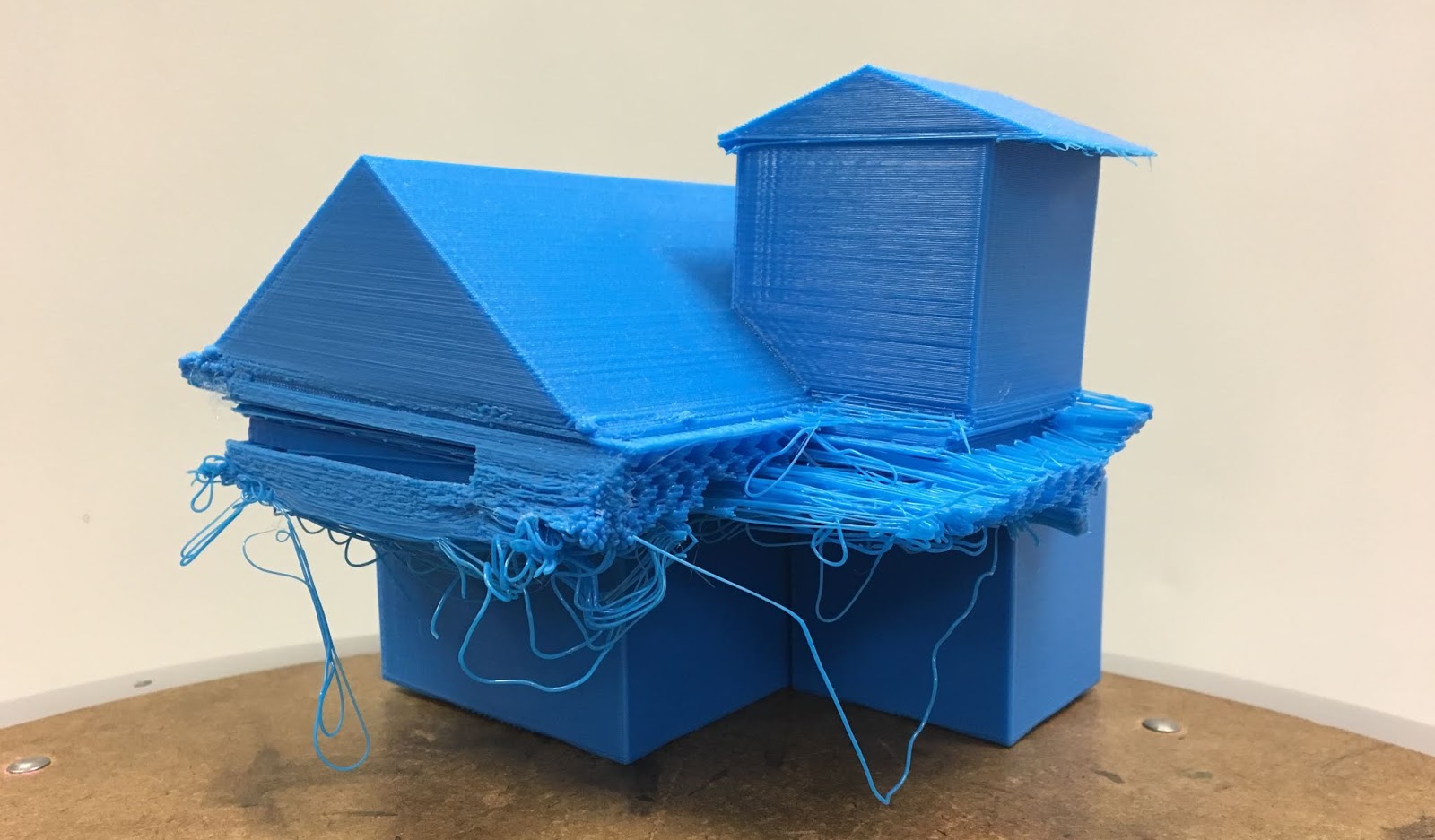
Failed 3-D print.
So we take a different approach to learning here.

An engineer is somebody who uses their mind to solve problems in real life. Technology is a thing invented via the engineering and design process to solve problems. Our makerspace, CREATE, is where those things come together.

But we're not an engineering principles class. We encourage students to not only define their own techniques, we ask them to define their own goals. CREATE's culture is deliberately built as a safe place for failure — and learning by analyzing those failures. Questions like "Why didn't it do what I want?" and "How can I change it to make it better?" are the background music that indicates learning success.

We can't reliably guess where our students will end-up. So we must provide them not only with the techniques to learn anything, but with the confidence that they can do anything.


Thursday, March 14, 2019

Aspirations, not standards


Integrating MakerEd into education has to honor the expectation of benchmarks, if not standards. Even though I've been really plugged-in to social media for decades, I couldn't find a list of maker skill progressions anywhere. So, with the help of people all over the country, I made a Maker Skills Progression Google Sheet. It's a living document that still has some gaps. Please feel free to comment on it.


This rubric is a spectrum of mastery levels for particular skills. In other words, "Once you do this, then you can aim at this." It’s a tool for teachers to encourage progress, regardless of a specific student's starting point. It can be used for any age. For example, I’m probably a Level B in sewing and a Level D in soldering. We should not expect, let alone require, students to be all Es in all skills.

These aren't standards. (Not standards!) They are aim points and guides for individual classroom teachers. It should be perfectly acceptable for a given student to be a Level B in one skill and an E in another. The rubrics are strictly aspirational. Origami and 3-D design do not have to be for everybody.

Once students are at Level E, then that skill is just a tool they’re good with. After that, it’s totally about their content — what they make and its educational validity.

As a teacher, the levels let you know what quality level of craftsmanship to expect from a student. Theoretically, a student with B-level skills and a student with E-level skills could both get graded highly on a given project — if they have great content. Conversely, a student with E-level skills could get a low grade if they didn’t work up to their known level of craftsmanship.

It's a challenge to educate the profession that this is not a continuation of the way we’ve always done things. If a teacher is looking for standards boxes to check off, then we have not done our job right in educating them about how maker education works. Traditionally trained teachers often look for checkbox standards and we need to head them off. Early childhood development experts, physicians and occupational therapists can identify what specific hand-eye coordination and manipulative benchmarks are appropriate for a given age. Those evaluations lie outside of mainstream maker ed.


Tuesday, February 12, 2019

Learning to "ROAR"

CREATE(ing) time


If you ask any teacher what one thing that they need more of (besides money) they will tell you that they need more time. We found a way to "create" more time for teachers without diminishing the students' classroom experience. For a week each month, we bring in substitute teachers for each grade level per day and send their students on an all-day rotation through STEAM activities. The teachers spend the entire day on professional development and prep time.


Tuesday, January 29, 2019

Making Sacrifices

Sacrificial workbench tops

Wear and tear is one of the things built into our workbenches. Students will cut without mats, scraping-up hot glue damages the work surfaces. In other words: School happens. So the tops of our workbenches are sacrificial. Every year or two, we rip them off (they're attached with a minimum of silicone glue) and replace them with new tops.

Old bench top about to be replaced. New surface is visible in the rear.
Our original tabletops were a thin white plastic designed to be attached to a wall. But it was so thin, that when the temperature in the room changed, the material warped and made for an uneven work surface. The second version was whiteboard paneling, but the white surface was too thin to withstand day-to-day punishment (see photo above.)

Our current version is fused laminate board, designed for custom cabinets. It's actually donated scrap from a local company, which they generously cut to the exact size for us. As of this writing, it's been in use for five months and is standing up very well.

Links

Workbench Plans

Original surface (bad)

Donated sheets of thermal fused laminate board


Thursday, May 10, 2018

Making hot glue guns safer

We rely a great deal on the kindness of strangers. Sort-of strangers, actually. Much of our material is donated by our families or by businesses with ties to our staff and others. We were recently gifted with three gently used hot glue guns. The problem was that they were switchable between low temperature (105C) and high temperature (165C.) While 105C is hot enough to get your attention and even cause tears in a student, the burns are typically minor and painless after less than an hour. High-temp hot glue guns can quickly cause serious burns and scarring if not treated quickly.


So I broke them. Well, not exactly broke. I disabled the temperature switch after setting it to low temperature by putting a drop of hot glue into it.

Thank you, strangers. (The stranger in this case was Mrs. Mark, who finally decided to part with our in-home elementary arts and crafts tools. Our youngest kids are now in college.)

Thursday, March 29, 2018

Resurrecting CREATE

Last Spring, our campus became a construction site. Portable classrooms were trucked in, regular classrooms were emptied, concrete broken up and poured, all while school continued. Our administration building, including the staff' lounge, was closed down with the main office moving into a portable. This meant that CREATE would be temporarily repurposed as a combination of the staff lunch room, copy room and, for good measure, we moved the staff mailboxes in. All of the makerspace stuff was packed into boxes and stored.


When the students returned in August, there was a lot of residual campus makerspace culture that had lacked a central place of expression. I constantly fielded questions from frustrated makers who wanted to know when CREATE would reopen.

But our maker culture has more momentum than anything that could be overcome by the temporary closure of CREATE. As I've said many times, all of De Vargas is a makerspace. Making continued in classrooms in concert with our Project Based Learning ethos. But, that tinker time itch of free making was still not getting scratched.

On Halloween, that ended...

The storage containers disgorged their contents of boxes marked "Room 8," (CREATE's "real" name.)  Over two weeks I unpacked and restored the room to our friendly, comfortable, making environment. I was able to revisit some of our storage and removed almost all of the remaining cabinet doors. The only ones left cover dangerous tools or materials, cleaning supplies, and sink plumbing. Everything else is now wide open with much more in the students' reach.

We're back to campus normal again.

Thursday, September 7, 2017

CREATE Adds a Lego Wall


More than a year after our Donors Choose campaign, we finally inaugurated our Lego wall. Here's the explainer video: